IVR & auto attendant diagrams

IVR call flow diagrams your customers can actually read.

Map an auto attendant the way it really routes: the number that rings in, the holiday and business hours check, the menu and every option, timeout and invalid entry, the ring groups, extensions and voicemail behind them. Each step holds its prompt wording and audio file, and the PDF spells out every route.

On your phone? The editor is made for a computer. Email yourself a link and open the template at your desk. Email me a link for my computer
Opens the real editor in your browser. No account needed to look around; the free trial (no credit card) adds saving and export.
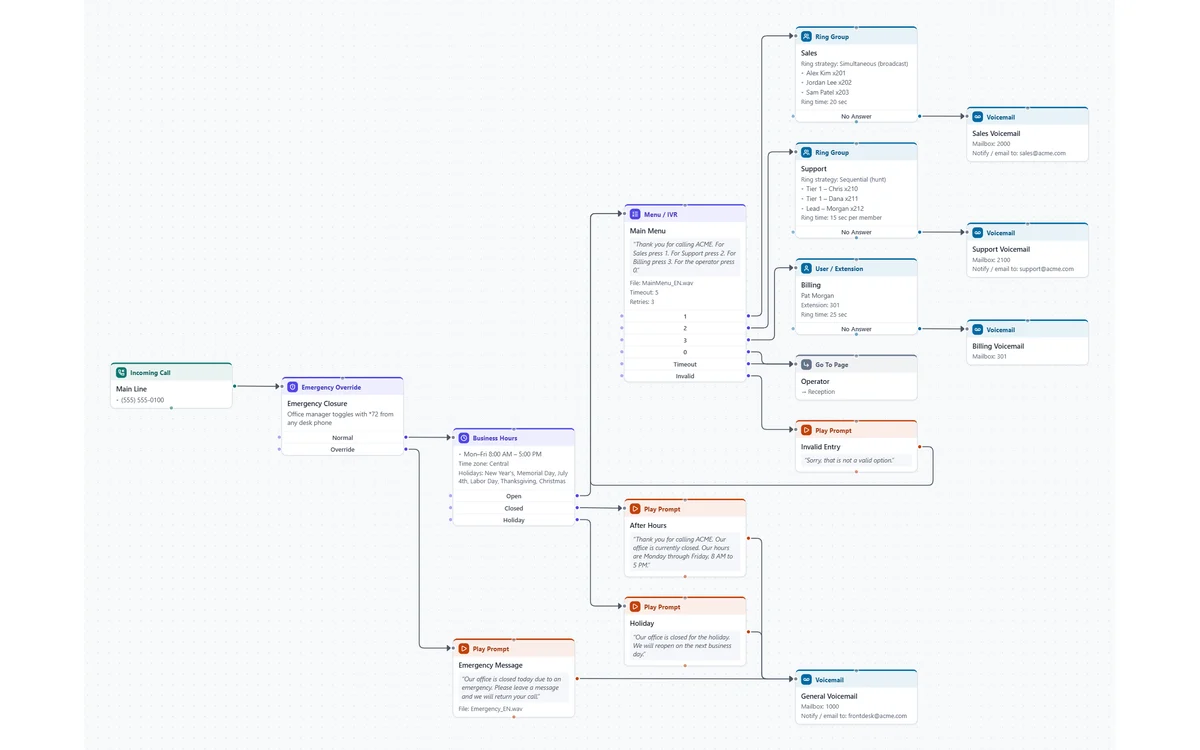
The Main Line template: incoming call, emergency override, business hours, a main menu with options 1, 2, 3 and 0, ring groups, an extension and voicemail

What's in the Main Line template

A typical small-business main number you can rename and reshape in a few minutes.

Hours and holidays

An emergency closure override, then business hours with time zone and holidays, each with its own message.

Main menu

Press 1 for Sales, 2 for Support, 3 for Billing and 0 for the operator, with timeout, retries and an invalid-entry prompt.

Real destinations

A broadcast ring group, a sequential hunt group, a direct extension, and voicemail boxes with email notification.

Two pages, two languages

The operator's shared line lives on its own page, linked with a Go To step, and prompts are written in English and Spanish.

Made for the people who build phone systems

Real telephony steps

Menus, business hours, emergency overrides, ring groups, shared lines, dial by name, voicemail, external transfers, conditions, data dips and variables.

Drag an exit, pick the next step

Every option (1, 2, Timeout, No Answer…) is its own exit. Drag from it, choose the next step, and it's added and connected in one go.

Prompt wording and files

Each step keeps what the caller hears and the audio file name, so the diagram doubles as the script for recording prompts.

Multi-language

Write prompts in several languages and switch the whole diagram between them. Check flags any step still missing a translation.

Catches loose ends

Check finds exits that go nowhere and steps nothing reaches, before the customer finds them by calling.

A PDF clients understand

A title block, one diagram per page, and a written spec of every prompt, member and route, from Letter to 11×17.

Questions

Which phone systems does it work with?

Any of them. It's vendor-neutral, so you can document RingCentral, Teams, 3CX, FreePBX, Cisco, Avaya, Mitel or anything else with menus and routing. It's a documentation tool, not a connector: it never logs in to or changes your phone system.

Can I document a contact center too?

Yes. Queues, agent availability checks, queue position and wait time, callback offers and surveys are built in. More about contact center call flows.

Can I hand the diagram to a customer?

That's what the PDF is for: a title block with customer and version, the diagram, and a written spec of every prompt and route. During the free trial, exports are watermarked.

What does it cost?

Trying the editor is free with no account. The free trial runs 7 days with every feature. After that it's $9 a month billed yearly, or $15 month to month, and it includes NetworkSketch for network diagrams. Pricing.

See the Main Line template in your browser.

No signup to look around. Change the menu options, add your ring groups, and start the trial when you want the PDF.

Open the template